
Document an integration, then run it.
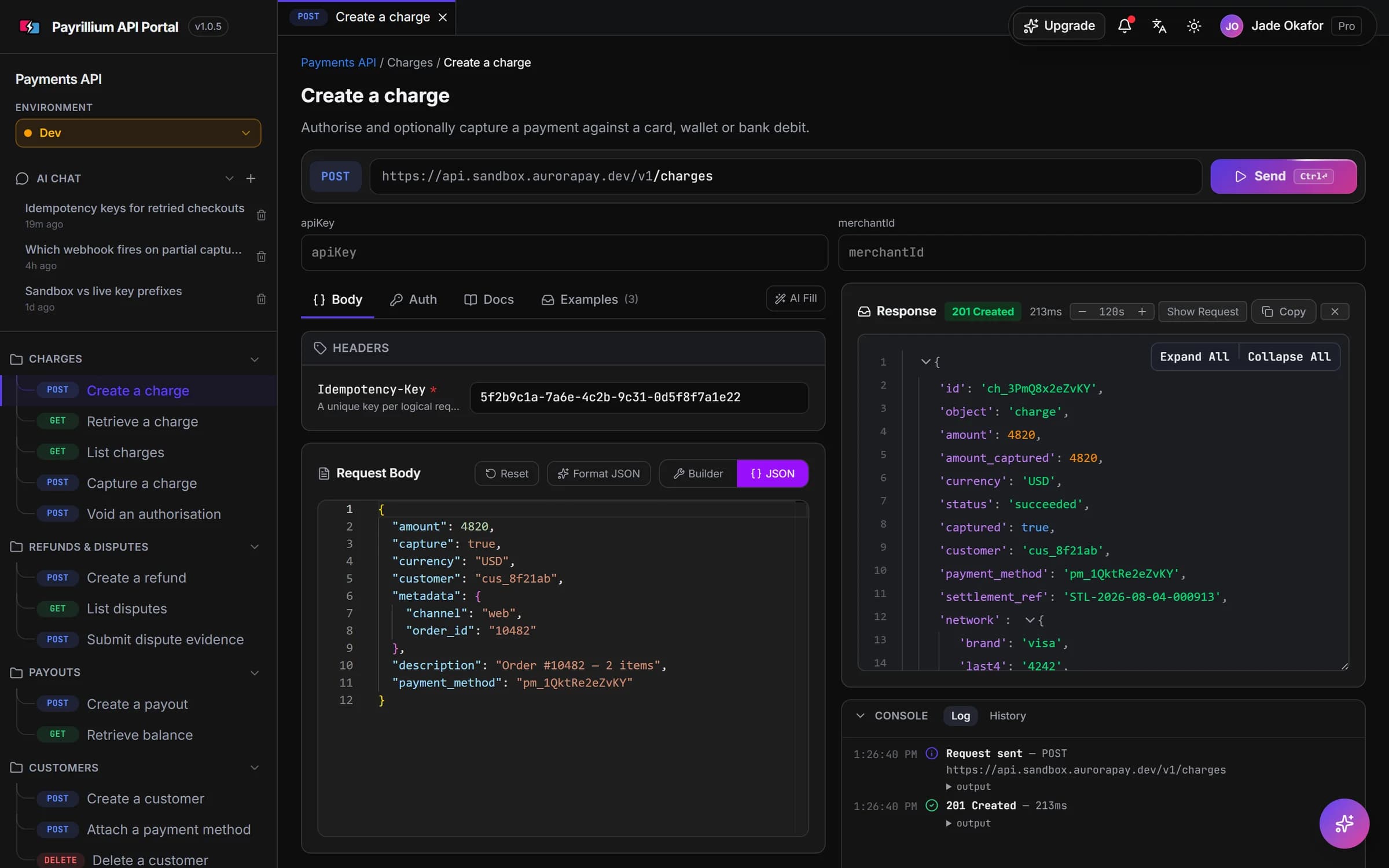
Your team and your clients read the API reference, look up errors and send live requests from the same place.
- HTTP
- GraphQL
- gRPC
- WebSocket
- Socket.IO
- SSE
- MQTT
- Webhook
- MCP Server
Routines
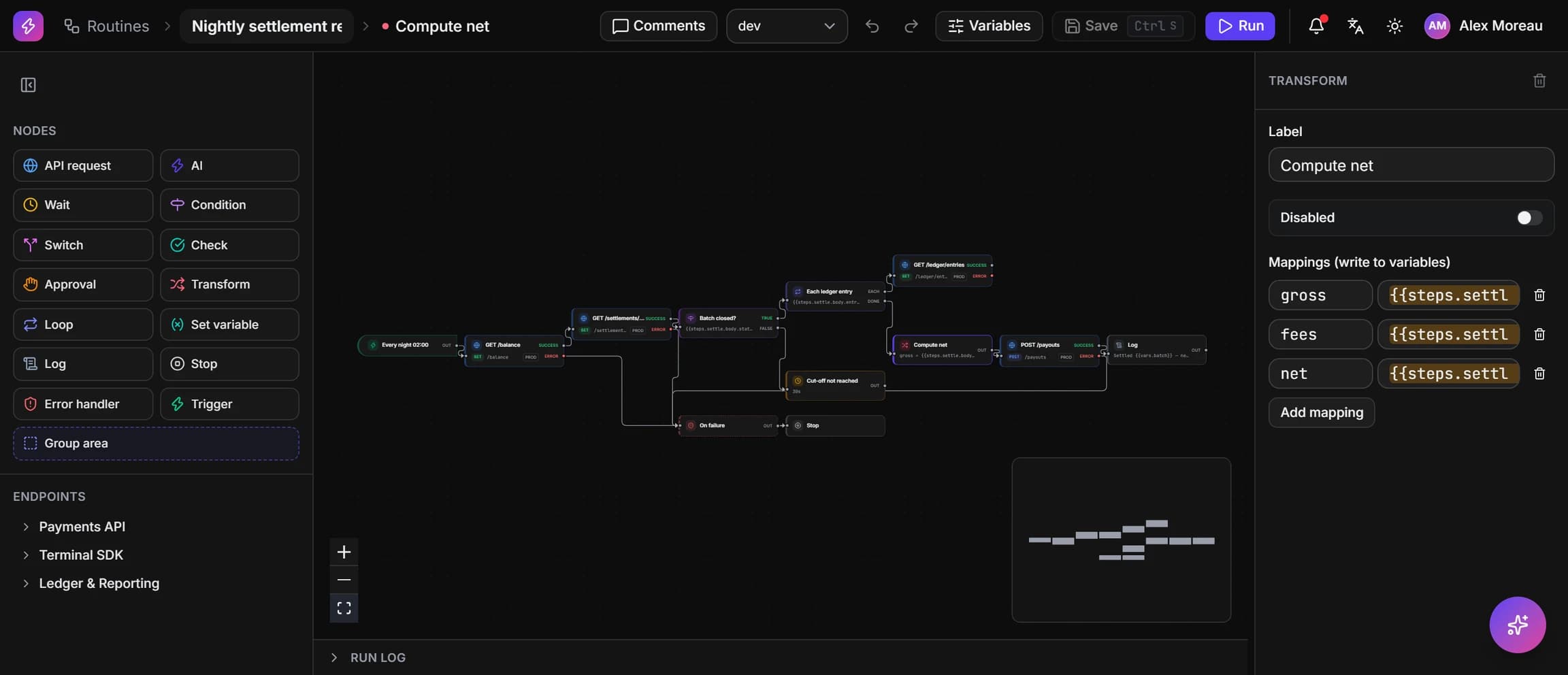
Every step on one canvas.
Drag API calls, conditions, loops, approvals and error handlers onto a canvas and wire them together. Variables pass from one step to the next, and the run log keeps every execution.
Read it, run it, ship it.
The same request you are reading is the request you can send. Change a field, press run, and the response comes back from your own tenant.
Example request. POST /v1/charges with an Authorization bearer key, and a JSON body carrying amount 1899, currency usd, terminal atm_7Q31D and mode semi_integrated. The response is 200 OK in 412 milliseconds, with charge id ch_1NqL8v, status approved, network visa and entry contactless.
What’s inside the Ops Center.
01Live requests
Send the request from the docs.
Each endpoint runs from the browser and shows the real response and how long it took.
02Assistant
Ask the documentation.
It answers from the API reference you published.
03Workflows
Automate on a visual canvas.
Build routines with conditions and loops, using secrets stored in the Ops Center.
04Errors
Every response the platform can return.
Each code comes with its cause and what to do next.
05Projects
Your whole API in one project.
The team works from the same endpoints, folders and parameters.
06Tenants
Client access under your own brand.
Scope what each partner sees, and put your name on it.
Integration
Six ways in.
Every mode talks to the same session manager, so you write the payment logic once. When you move from the local network to the cloud, you change the transport and the payment code stays as it is.
| Mode | Transport | Where the caller runs |
|---|---|---|
| Standalone | On the terminal | The terminal runs the whole application |
| POS Mode | On the terminal | A built‑in point of sale for a compact catalogue |
| Semi‑integrated | HTTPS POST | An existing POS or ECR on the local network |
| Cloud | HTTPS and webhooks | A central platform over the public internet |
| App‑to‑app | HTTP on localhost | A customer’s own application on the device |
| MCP serverFirst to publish | Model Context Protocol | A chat client driving a card‑present sale |
Transports
The protocol is a parameter.
You pick the protocol with one field on the request. A partner that already speaks gRPC reaches the terminal over gRPC and never has to learn REST.
 GraphQL
 gRPC
gRPC WebSocket
 Socket.IO
 MQTT
MQTT
 Webhook
 MCP Server
A Postman or OpenAPI collection imports with its folders, parameters and saved examples intact.
Requests go to your own tenant, so the body, status code and timing you see are real.
Partners see only what you grant them, and every page they see carries your branding.
The Ops Center runs in the browser, so there is no desktop client to keep updated on every machine.
Change plans in either direction and your estate, projects and saved examples stay where they are.
It is 2am somewhere.The documentation still answers.
Pricing
Send the request.
Pricing questions go straight to the engineers who built the platform. Tell us what you’re running and an engineer replies with a quote.
Or write to sales@payrillium.com.We only use your email to reply.